
learning about Mexmûr
a displaced population of more than 10,000 Kurds in Iraqi-occupied Kurdistan have been building a new society from the ground up since 1998

A couple weeks ago, the Providence General Assembly organized a screening of “Belkî Sibê, a film about war and revolution in the feminist, autonomous territory known as Rojava in Kurdistan (North and East Syria).
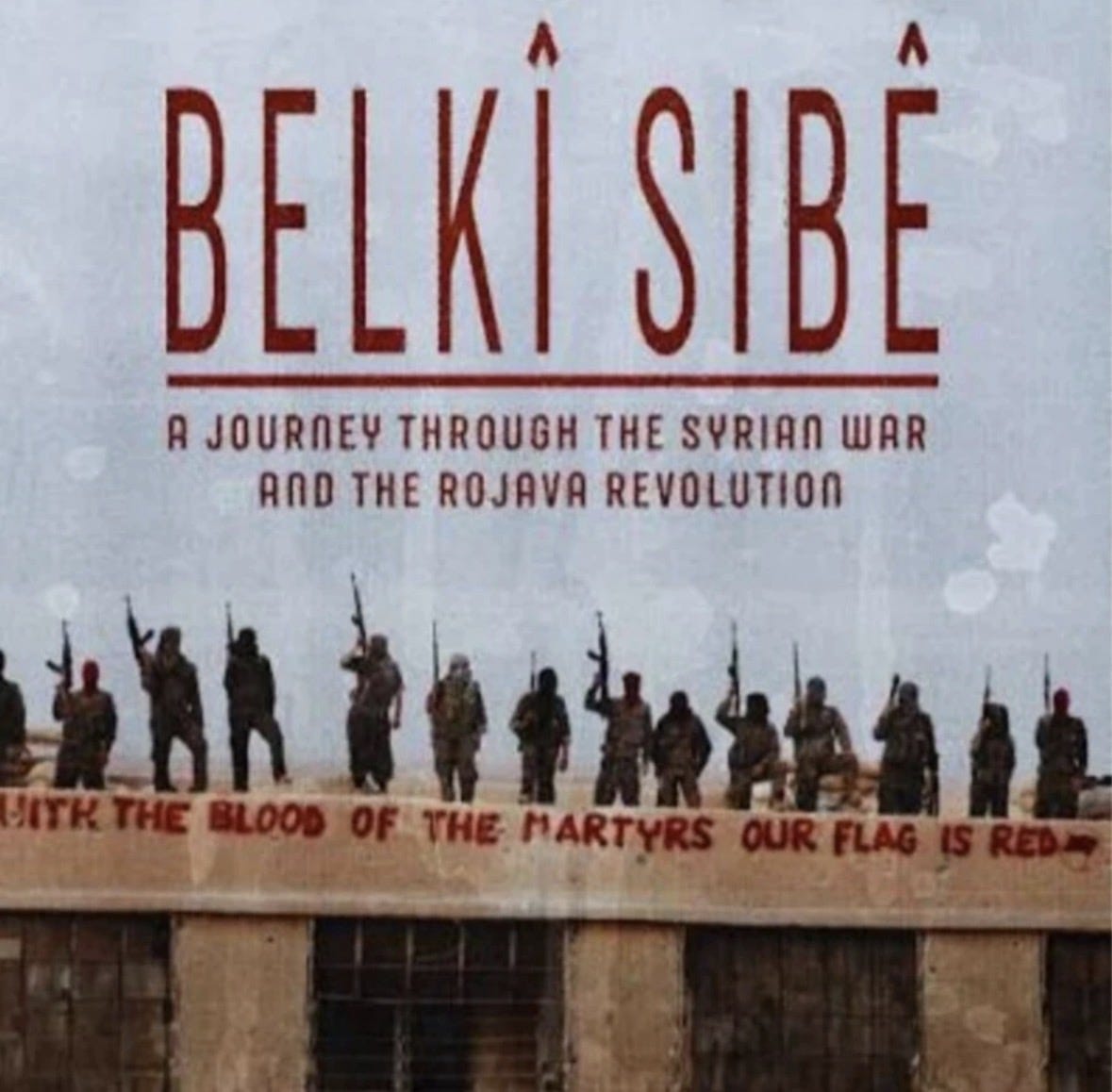
The film (free on YouTube!) gives a glimpse of what it was like to join the front lines against ISIS alongside the Greek filmmaker Alexis Daloumis, who served as a fighter for the International Freedom Battalion (IFB) of the Syrian Democratic Forces (SDF). You hear about the fighters’ excitement while crossing stealthily into the region by boat, and the oscillation of boredom and terror that followed. You see dismembered ISIS bodies “artistically” strewn amid the everpresent rubble, and meet chain smoking Marxist-Leninists who dance and cook and fight alongside queer masked anarchists.
If it were just another war film, though, I wouldn’t feel that excited by it. Years after serving on the frontlines, Daloumis went back to interview hundreds of people living within, and organizing, the revolution he fought for. The result is a radically honest portrayal of the revolution’s shortcomings and successes, in line with the Kurdish movement’s culture of critic and self-critic (tekmil). On the one hand there’s ample footage of residents in Manbij condemning ISIS’s terrifying takeover of their city and jubiliantly celebrating its liberation by the SDF. ISIS, some said, would behead people in the streets for speaking a single word and forced women to wear burkas whenever they left the house. “The living situation has changed a lot since the Syrian Democratic Forces came,” one man says. “The change is like the distance between the earth and the sky.” But then Daloumis also shows footage of some critics. “Not much changed for the better! Not much at all,” one underwhelmed man says. “All that changed is we can smoke cigarettes, roll up our pants and shave our beards!” Dolumis and his IFB comrades grapple with some of the revolution’s major contradictions. After a unit in the IFB formed and announced a queer contingent, the SDF leadership first denied its existence, and then wrote a disparaging statement about it. The chain smoking marxist leninst stressed that we have to understand that the region hasn’t had a similar sexual revolution to the one we’ve had in the west.
After the film, we hosted a Q&A session with G., a of the International Freedom Battalion, and K., a scholar of political anthropology who has lived and worked in Kurdistan. My ears perked up when K. mentioned that the most pure form of democratic confederalism—the stateless, directly democratic political system that the Kurdish liberation movement was building in Rojava — is being practiced at a large refugee camp called Mexmûr in Iraqi-occupied Kurdistan. I’ve been learning about and organizing around Rojava for seven or eight years now, yet I’d barely heard of this camp. Mexmûr immediately struck me as an essential piece of the puzzle for understanding what made Rojava possible.
The next morning I opened Kurdish scholar Dilar Dirik’s book The Kurdish Women’s Movement History Theory, Practice—a birthday present from my friend A.— and found a chapter on Mexmûr. Dirik told the story of how, during the early 1990s, the Turkish state attempted to force Kurdish villages to cooperate with them against the Kurdistan Worker’s Party (PKK). Instead of collaborating, 15,000 people fled their homes and crossed the border into Iraqi-occupied Kurdistan. After years of displacement and violence waged by the Turkish Army and the Kurdish Democratic Party (the ruling party in Southern Kurdistan with a cozy relationship to the Turkish state), the refugees settled in Mexmûr in 1998. Dirik quotes a resident to describe the camp’s origins:
“When we first arrived, we found ourselves in the middle of a desert without water or shelter. Children died from mines, scorpions, and snakes. But every family picked up a tool and helped build up this place that first consisted of tents, then became a village and is now a small town in which we implement an alternative democratic system.”
What does this alternative democratic system look like? It’s worth reading Dirik’s book for more details, but here’s what stood out to me. There seems to be two main institutional pillars of the governance system: the People’s Assembly and the Municipal Administration. The People’s Assembly is the beating heart of the camp, representing the “organized form of the popular will.” It’s a decision making space with rotating Co-presidents (one man and one woman) from various Councils—for example, health, education, women’s, worker’s associations.
The Councils are made up of delegates from the Commune’s committees, which are the hyperlocal building blocks of the whole system. It’s unclear to me the extent to which Council Co-presidents make decisions for the Councils and Commune committees or if they simply represent the will of decisions that have already been made at the lower levels.
The other pillar—the Municipal Administration, manages public services—waste collection, food, etc.—and represents the camp to external institutions, to arrange funding or aid for example. The administration is directly accountable to the People’s Assembly.
The camp also organizes a varitety of women’s institutions. The Kurdish liberation movement sees man’s subjugation of women as the first hierarchy that formed, and the most essential to abolish for the liberation of all of society. The hierarchical state is the institutionalization of domineering masculine ideals. In Mexmûr (and throughout Rojava), Women’s Assemblies and Youth Women’s Assemblies bring the various women’s institutions together. The Sehid Jiyan Women’s Academy hosts women to give them a break from housework in a stimulating environment where they can discuss formerly taboo topics like sexual health. The academy has invited men to come reflect on their sexism, too. I wonder how that went.
K. also mentioned the most detailed ethnography of Mexmûr written by Arzu Yılmaz hasn’t yet been translated into English unfortunately, and sent me this interview where Yilmaz touches on her research in Mexmûr. One of her main findings from her extensive research was that the Kurdistan Worker’s Party’s (PKK) policies were influenced by the praxis of refugees (like those in Mexmûr ). Mexmûr was not a “PKK military bases” as some assume - it has its own unique identity and practices as refugees.
After all this, I’m left wondering, what’s our Mexmûr in the U.S.? That is, where can we practice building autonomous infrastructure in a (relatively) pure form on a (relatively) large scale? Of course, thousands of hippies dropped out of mainstream society in the late 60s- mid-70s to practice egalitarian ways of relating, and many of those experiments imploded after a short amount of time. I’m curious to learn more about how they organized themselves, and how they conceived of themselves ideologically. My friend Z. recommended Zen and the Art of Motorcycle Maintenance as a good place to start. (More insights and recommendations are welcome.)
There’s a story line—with some eerie archival footage that will forever be etched in my brain—about the hippie commune movement in Adam Curtis’s All Watched Over By Machines of Loving Grace—another recommendation from Z. Curtis says the hippies formed egalitarian communes without leaders in an attempt to mirror the ecological world’s self-balancing capabilities. He argues the belief system underpinning the movement was false. Natural ecologies are dynamic, ever-changing systems.
Why did the hippie communes fall apart after a few years or less, while Mexmûr has been able to steadily collectively organize on a massive scale for nearly 30 years now? In some ways it’s absurd to even compare the two. But maybe by asking this question, we can dispel the idea that experiments with self-governance are necessarily doomed to fail, as many in the west seem to believe, and learn some lessons from an enduring experiment in mass democratic organizing.
Of course the biggest difference is that the hippies chose to embark on their utopian adventures, and could leave whenever they wanted, while the Kurds were coerced into leaving their homes and are forbidden from returning.
Still, the villagers probably could have dispersed, or the camp could have devolved into absolute chaos. It probably didn’t, in part because the Kurdish liberation movement had been organizing for several decades prior to Mexmûr with a very self-aware ideological and organizational framework, continually reinforced through political education infrastructure, and refined by struggle and critic/self-critic. Even if the refugees in Mexmûr had their own identity that was separate from the PKK, they were a part of this broader political lineage. Did the hippies learn lessons from the political lineages that came before them, or were they operating with historical amnesia?
Another key difference seems to be that Mexmûr’s governance structures includes mechanisms and strucutures for limiting any one individual’s or group’s power over another. Under democratic confederalism systems, leadership roles rotate frequently, and the women’s institutions serve as counter-power against patriarchy, for example. In the communes, according to Curtis, certain individuals were able to quickly amass power over others and this contributed to a culture of fear. In my experience, people with narcissistic tendencies have a field day in disorganized groups, the classic tyranny of structurelessness problem. Our spaces will begin to mirror the hierarchial, oppressive systems we live under if they lack well-organized systems for counteracting those forces.
Both the hippies and the Kurdish liberation movement practice(d) critic and self-critic (a maoist tradition). Curtis says they devolved into toxic shame sessions in the communes. I’m curious to learn more about the various processes differed from each other. I suspect the west’s individualistic culture factored into the abuses of power. Based on what I’ve read about critic and self-critic in Kurdish movement, an individual’s behavior is analysed in relation to the influence of capitalist and patriarchal mentalities. It’s not just that Karen’s an asshole, but that Karen’s behaviors have been influenced by the capitalist, patriarchical, racist society we’ve all been subjected to together.
Lots more to be said on this, these are just some quick initial thoughts and questions. Beyond those, I’ve been channeling my reinvigorated energy into helping organize a (hopefully very vibey) volleyball tournament as a fundraiser for Heyva Sor, a relief organization that provides support for the hundreds of thousands displaced by the Turkish state in the region, including in Mexmûr. I hope to report back on that <3
Very interesting article. It may be worthwhile to pursue why the hippie movement collapsed… I have a copy of Zen and the Art of Motorcycle Maintenance.